Perugino and the Collegio del Cambio in Perugia
During the Middle Ages and Renaissance, traveling across Italy meant having to change money frequently because most towns and regions had their own currency.
Besides spending money on food and lodging, you would likely encounter tolls to cross bridges, taxes to pass through city gates, and customs fees if you were a merchant looking to exchange goods.
Fines could also be imposed for violating local regulations, adding another potential expense to your journey.

Passing through the ancient city gates of Perugia at the end of the fifteenth century, you would encounter a vibrant, thriving town at the crossroads of the Italian peninsula.
As a major hub along popular merchant routes, Perugia saw impressive economic growth over the course of the Middle Ages. To exchange your coins, you would have to navigate the winding streets until you reached the town hall and its adjacent money exchange, the Collegio del Cambio.
If the doors to the moneychangers’ audience hall were open, and if you were fortunate enough to peer inside, you might glimpse of Pietro Perugino’s assistants adorning the colorful ceiling of what would later be called “the most beautiful bank in the world.”

The Moneychangers of Perugia
Of the fourteen guilds of medieval Perugia, only the moneychangers had their headquarters situated inside the city’s main government building, the Palazzo dei Priori. Paradoxically, the Church considered usury a grave sin, yet Italians established the world’s earliest and most extensive banking system.
In any Italian town, those who exchanged and minted currency wielded substantial influence on the local economy, and consequently held significant power and prestige.
In exchange for the sin of profiting from money-lending, the bankers legitimized their profession by establishing and embellishing churches and charitable institutions. Close alliances forged between Perugian powerbrokers and the papacy facilitated this exchange.
To embellish the main audience hall of the Collegio del Cambio, the bankers of Perugia commissioned the most celebrated Umbrian painter of the time, Pietro Perugino (born Pietro Vannucci, ca. 1446-1523).
Along with planning a full decorative program of intricate marquetry and furnishings, Perugino was tasked with creating frescoes depicting a variety of Christian and mythological imagery to adorn the upper walls and ceiling.

At the time, Perugino was at the peak of his career, wealthy and famous, managing at least two workshops with numerous assistants and pupils. Approaching fifty years old, Perugino had relocated to Florence, where he had recently married, bought a home, and established a workshop.
In Perugia, he left his assistants behind to execute his vision for the Collegio program, using a series of full-scale drawings or cartoons that he had designed as templates. Perugino used and reused such templates on various projects, which gives his work a remarkable aesthetic coherence across his long career.
Among Perugino’s pupils working on the project was a fourteen-year-old orphan whose uncles had sent him to learn from the famous painter. The boy possessed extraordinary artistic skills, and he likely served as a model for the prophet Daniel, high up on the ceiling.
His name was Raphael Sanzio.
By the time the Collegio del Cambio project was complete three years later, Raphael became an independent artist, having surpassed his master.

Old Stories, New Faces
The upper half of the audience hall is awash in vivid colors and graceful figures, along with decorative frames unfolding across the structural parts of the vaults.
During Perugino’s time, it was common for artists to receive guidance from humanist scholars who helped develop a complex symbolic program that blended Christian iconography with mythological subjects. Perugino was responsible for bringing this program to life visually.
The frescoes feature an array of corresponding symbols, like pairing the zodiac with depictions of the Nativity and Transfiguration, as well as marrying biblical prophets with ancient Roman heroes, sibyls, and personifications of Justice, Prudence, Temperance, and Fortitude.
Apart from their ethereal beauty, one of the most fascinating aspects about Perugino’s frescoes is the depiction of these familiar biblical and mythological scenes represented with contemporary faces and dress.
Many art historians have attempted to pinpoint portraits of contemporary Perugians in the faces of these biblical and mythological figures. And the elegant costumes remind us that Perugia was the center of a thriving cloth trade.

The spandrels of the vaults feature seven planetary gods riding in chariots, each corresponding to the days of the week and zodiac signs. These roundels resemble large coins and reflect a burgeoning interest in numismatics and collecting ancient coins.
Below these frescoes, the moneychangers of Perugia carried out their daily work of guild meetings, weighing coins, and exchanging currencies. They especially valued the Florentine florin, which was the only currency that would have been as universally accepted in facilitating trade as the American dollar.
The completion of this elaborate decorative program solidified the Collegio del Cambio as a vital hub of commerce and finance in Perugia. It served as a testament to the resilient, enduring nature of the Umbrian people, and it cemented the city’s reputation as a thriving center of commerce in the heart of Italy.

The Best Painter in Italy
In November 1500, the banker Agostino Chigi, writing from Rome to his father back home in Siena, declared Perugino the “meglio maestro d’Italia”—the best master in Italy. Within a generation, Raphael would overshadow the reputation of the master known as “the Perugian,” but as the Collegio del Cambio was completed in 1500, Perugino still held his title.
At the completion of the work at the Collegio del Cambio, the moneychangers of Perugia were so satisfied with the result that they invited Perugino to add a self-portrait to the program. Positioned at the base of a vault, we find Perugino’s smug likeness: a middle-aged man with rosy cheeks and a double chin, his wispy hair emerging from a red cap.
Below the self-portrait is a Latin inscription calling Perugino an egregious pictor, or eminent painter. If the art of painting had been lost, the inscription reads, Perugino would have brought it back himself. And he wasn’t shy about saying so.
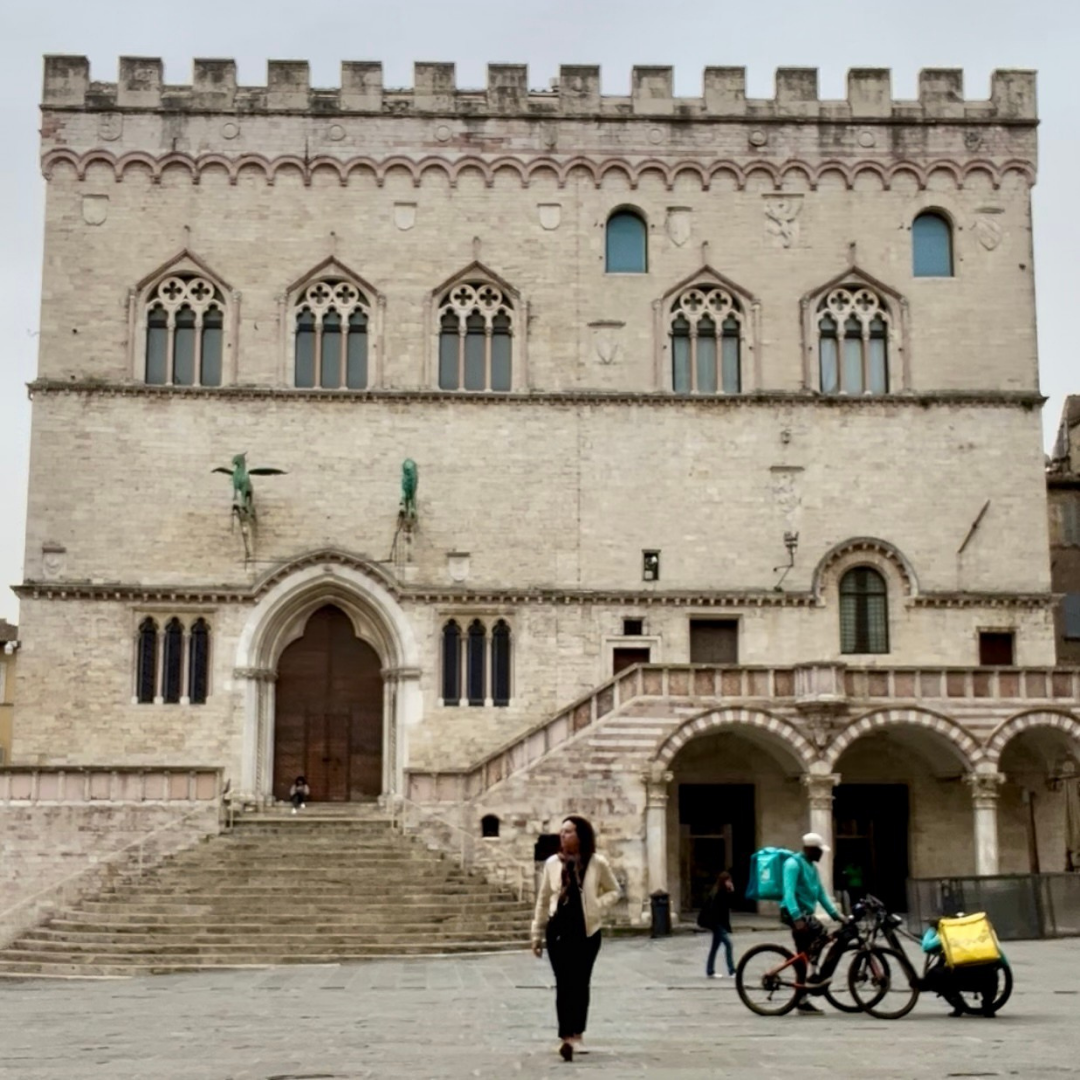
At the Palazzo dei Priori in Perugia. The audience hall of the moneychangers is on the ground floor of this beautiful medieval fortress. The paintings gallery, the Galleria Nazionale dell’Umbria, occupies the upper floors and displays many of Perugino’s masterpieces. Highly recommend.
Corso Pietro Vannucci, 25/D
06121 Perugia (PG)
+39 075 572 8599
Check the website for current visiting hours and seasonal events.
Have you visited the Collegio del Cambio in Perugia? Let me know in the comments below!


This is a fascinating article and I enjoyed it immensely! I learn so much from you and love poking around your website to read the links and videos you offer. I have read most of your books now and have ordered the last two. The stories are wonderful., and again, I learn so much! Love your interview too. I hope you are working on another book!
Love reading about itslian art history!!! Thank you